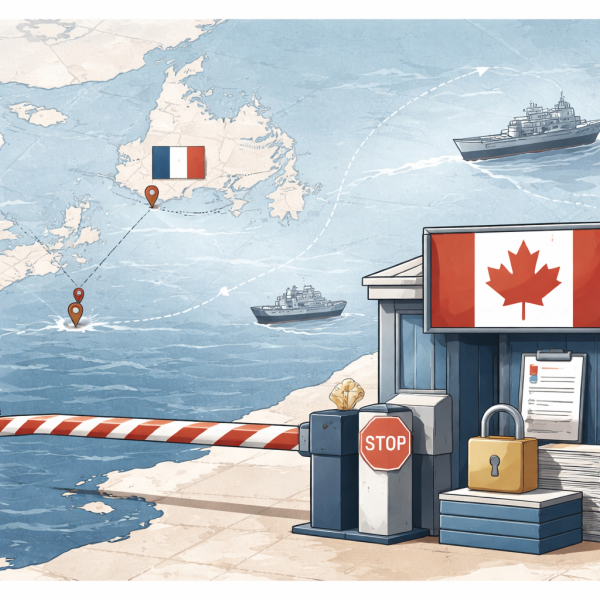
Canada expands eTA rule to sea arrivals from Saint-Pierre-et-Miquelon
Canada introduced a new entry requirement at 1:00 a.m. EDT on June 5, 2026, extending electronic travel authorization (eTA) rules to certain travellers arriving by sea from Saint-Pierre-et-Miquelon. The change affects most visa-exempt foreign nationals who previously did not need an eTA when entering Canada by vessel.
The update applies to those travelling by ferry, private boats, and commercial marine transport between the French territory and Canadian ports, including routes to Newfoundland and Labrador. Officials state the measure aligns maritime arrivals with existing pre-arrival screening processes used for air travellers.
The policy introduces additional screening requirements for a specific travel corridor that has seen increased activity, with federal authorities linking the change to efforts to maintain consistent border procedures across modes of transport.
- Effective date: June 5, 2026, at 1:00 a.m. EDT
- Applies to most visa-exempt travellers arriving by sea from Saint-Pierre-et-Miquelon
- Covers ferry, private vessel, and commercial marine arrivals
- eTA requirement aligns sea arrivals with air travel screening rules
- Exemptions include cruise passengers, certain seafarers, U.S. citizens, and specific French residents

Expansion of electronic travel authorization rules
The electronic travel authorization system has historically applied to visa-exempt foreign nationals arriving in Canada by air. Under the updated policy, the requirement now extends to most travellers entering by sea from Saint-Pierre-et-Miquelon, a French overseas territory located near Newfoundland and Labrador.
An eTA is a digital authorization linked to a traveller’s passport. Once approved, it is typically valid for up to five years or until the passport expires, whichever occurs first. Applications are submitted online and, in many cases, processed within minutes.
The expansion of the requirement reflects a broader effort to standardize entry procedures across different transportation methods. By including marine routes, authorities aim to ensure that pre-screening measures apply uniformly regardless of how travellers arrive in Canada.
Who is affected by the new requirement
The policy applies to most foreign nationals from visa-exempt countries who travel by sea from Saint-Pierre-et-Miquelon into Canada. This includes individuals arriving via ferry services, privately operated boats, and commercial marine vessels that are not classified as cruise ships.
Prior to this change, many of these travellers could enter Canada without obtaining an eTA, as the requirement was limited primarily to air travel. The updated rule introduces an additional administrative step for marine arrivals within this category.
There are no changes to entry requirements for individuals from countries that already require visas, as those travellers must continue to apply for a temporary resident visa before traveling to Canada.
Exemptions outlined by authorities
Federal authorities have identified several categories of travellers who are not subject to the new eTA requirement when arriving by sea from Saint-Pierre-et-Miquelon.
Passengers arriving on cruise ships are exempt, maintaining existing procedures for organized cruise travel. Seafarers working aboard commercial vessels, such as fishing crews, are also excluded due to the operational nature of their travel.
United States citizens and permanent residents are not affected by the change, reflecting longstanding bilateral travel arrangements between Canada and the United States. In addition, French citizens who reside in Saint-Pierre-et-Miquelon and travel directly to Canada are exempt under the new rules.
Rationale behind the policy change
According to federal communications, the adjustment was introduced in response to instances where travellers attempted to bypass standard pre-arrival screening requirements by entering Canada by sea rather than by air. Routes between Saint-Pierre-et-Miquelon and nearby Canadian communities, including Fortune in Newfoundland and Labrador, were specifically referenced.
By extending eTA requirements to these maritime routes, authorities have sought to close gaps in the screening process and ensure consistency across points of entry. The measure is part of broader efforts to maintain border integrity while continuing to facilitate travel and regional connections.
The policy reflects a balance between security considerations and the economic and tourism relationships that exist between Canada and Saint-Pierre-et-Miquelon, which have historically involved regular cross-border marine travel.
How the eTA system functions
The eTA is electronically linked to a traveller’s passport and remains valid for multiple entries over a period of up to five years. It enables Canadian authorities to conduct pre-arrival checks on travellers from visa-exempt countries before they reach the border.
Applicants are required to provide personal information, passport details, and responses to eligibility questions as part of the online application process. In most cases, approvals are issued rapidly, although additional review may be required in certain situations.
The system was originally introduced to strengthen border management by identifying potential inadmissibility concerns before travellers depart for Canada. The expansion to marine travel routes represents a continuation of that objective.
Relation to broader immigration systems
The eTA operates alongside other Canadian immigration screening tools and programs, including visa processes and permanent residence selection systems. While it does not confer immigration status, it serves as a preliminary authorization for entry.
Canada’s broader immigration framework includes programs such as Express Entry and provincial nominee programs, which are tracked through updates like those listed on the Express Entry draws index. These systems govern longer-term immigration pathways, whereas the eTA addresses short-term entry for visitors and certain temporary travellers.
Regional and logistical context
Saint-Pierre-et-Miquelon is located just off the coast of Newfoundland and Labrador, making it one of the closest international jurisdictions to mainland Canada. Ferry routes and private vessels frequently connect the islands with Canadian ports, supporting local commerce, tourism, and community ties.
The introduction of the eTA requirement for this corridor represents a targeted policy adjustment focused on a geographically specific travel route. It does not alter entry rules for travellers arriving by sea from other regions unless they fall under existing requirements.
Authorities have emphasized that the change is limited in scope and does not affect the majority of international marine travel to Canada, particularly for cruise operations or other established categories that already follow separate procedures.
Ongoing updates and monitoring
The June 2026 implementation marks a recent development in Canada’s evolving border management policies. Federal departments continue to review entry requirements to address emerging travel patterns and operational considerations.
As with previous adjustments to entry systems, the impact of the expanded eTA requirement is expected to be monitored over time, particularly in regions where cross-border marine travel is common.
Further reporting on Canadian immigration policy developments, including updates involving regional programs and entry requirements, continues to be tracked alongside official announcements and system changes.