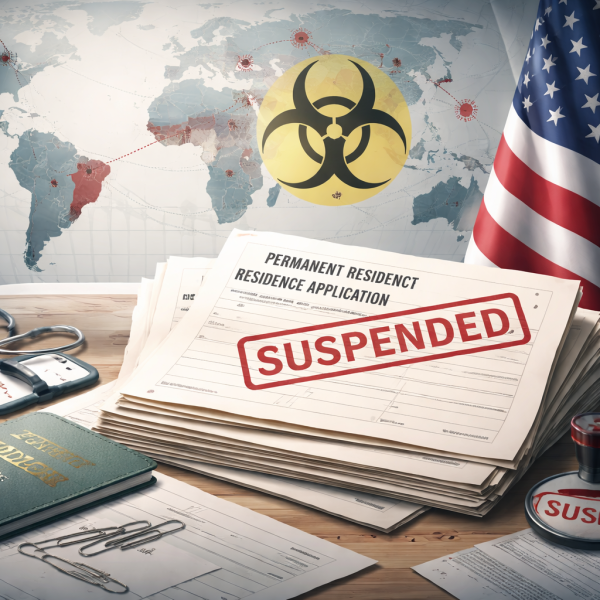
Canada suspends 36,000 PR applications under Ebola order
As of May 24, 2026, the federal government has paused processing for 36,060 permanent residence (PR) applications tied to foreign nationals residing in the Democratic Republic of the Congo, Uganda, and the Republic of South Sudan.
The action forms part of public health measures linked to Ebola risk, with authorities also halting the issuance of permanent resident visas for affected individuals.
Approximately 1,700 holders of already-issued PR visas are currently unable to travel to Canada while the order remains in force.
- 36,060 permanent residence applications paused as of May 24, 2026
- Measure targets residents of DR Congo, Uganda, and South Sudan
- About 1,700 approved PR visa holders unable to travel
- Temporary resident visas and travel authorizations also affected
- Order took effect on May 27, 2026, for a 90-day period
- Authority implemented under newly enacted Bill C-12 provisions

Breakdown of affected permanent residence applications
Government data indicates that Uganda accounts for the largest share of paused applications, with 31,324 cases, followed by 4,037 linked to the Democratic Republic of the Congo and 699 tied to South Sudan.
The majority of impacted files fall under the protected persons category, which includes refugee-related cases. This segment represents 30,665 applications across the three countries.
Family sponsorship pathways account for 3,409 paused applications, while economic immigration streams represent 641 cases. Smaller volumes are recorded under humanitarian and compassionate considerations and other classifications.
Distribution by immigration category
Protected persons applications form the largest portion across all three affected countries, particularly in Uganda, where over 28,000 cases are currently on hold.
Family-based immigration represents the second-largest category, followed by humanitarian and public policy streams. Economic immigration forms a comparatively smaller share of the paused inventory.
Temporary residence documents and travel restrictions
The order extends beyond permanent immigration pathways, affecting temporary residence documents including temporary resident visas (TRVs), electronic travel authorizations (eTAs), study permits, and work permits.
As of May 26, 2026, a total of 24,548 individuals from the three countries held valid temporary or permanent resident travel documents but had not yet entered Canada.
Among these, 22,816 cases relate to temporary residents, with high volumes of TRVs recorded for both the Democratic Republic of the Congo and Uganda.
Study permits, work permits, and other temporary entries represent smaller portions of the total, while extensions for these permits are minimal or absent in the available data.
Additional applications in processing inventory
Immigration, Refugees and Citizenship Canada (IRCC) reported a further 7,751 temporary residence applications in its inventory connected to individuals residing in the affected countries.
These applications include a mix of visitor visas, study permits, work permits, and travel authorizations that are now subject to the suspension.
Legal basis for the suspension
The measures were enacted under the federal order titled Minimizing the Risk of Exposure to Ebola Disease in Canada (Immigration Applications and Documents).
The government classified the Democratic Republic of the Congo, Uganda, and South Sudan as posing a high or very high risk for Ebola outbreaks, prompting the temporary restrictions.
The order prevents the processing of affected applications and bars travel to Canada for impacted document holders, unless specific exemptions apply.
Role of Bill C-12
This marks the first use of authorities granted under Bill C-12, which came into force on March 26, 2026.
The legislation allows the federal government to suspend, cancel, or modify immigration applications and documents in response to public health or other risks.
It also gives the Governor in Council expanded powers over both permanent and temporary resident streams, including visas, permits, and travel authorizations.
Exemptions and humanitarian considerations
While the suspension applies broadly, the Minister of Citizenship and Immigration retains discretion to grant exemptions in specific situations.
These may include cases involving urgent protection needs or other humanitarian and compassionate grounds, as provided under the order.
No detailed figures have been released regarding the number of exemptions granted since the measure took effect.
Context within Canada’s immigration system
Canada’s immigration framework includes multiple pathways such as economic immigration, family reunification, and refugee resettlement, as well as provincial nominee programs administered across regions.
Programs like the Manitoba Provincial Nominee Program (MPNP) operate alongside federal streams but are not directly referenced in the current suspension order.
The paused applications reflect a cross-section of these immigration pathways, with humanitarian and protected persons categories making up a significant portion in this instance.
Duration and scope of the measures
The suspension came into effect on May 27, 2026, and is set to remain in place for 90 days from that date.
During this period, affected applications will not be processed, and travel to Canada is restricted for impacted foreign nationals holding valid documents.
The policy applies specifically to individuals residing in the identified countries, regardless of citizenship in some cases, depending on immigration records.
Data sources and reporting timeline
The figures cited in the order are drawn from official federal publications, including the Canada Gazette, with data current as of June 12, 2026.
Application and document counts reflect inventories recorded in late May, including May 24 and May 26 reference points for permanent and temporary residence data.
Updates to the policy or processing status may be issued as the 90-day period progresses.
Ongoing developments
The situation remains subject to change, particularly as public health assessments evolve and new data becomes available.
Federal authorities have not indicated whether the suspension will be extended beyond the initial 90-day timeframe.
The current order continues to affect 36,060 permanent residence applications and thousands of travel documents, including approximately 1,700 issued PR visas that remain temporarily unusable.