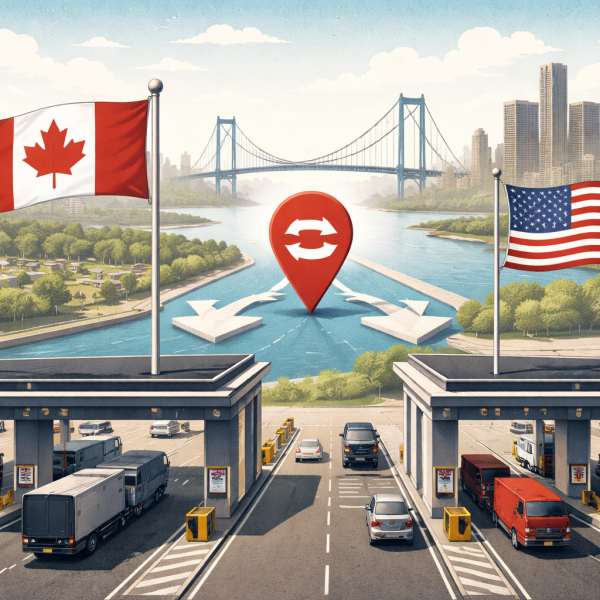
Gordie Howe Bridge Opens New Canada–U.S. Crossing
The Gordie Howe International Bridge began operations on July 27, 2026, adding a third land crossing between Windsor, Ontario, and Detroit, Michigan. The opening introduces a new route at one of the busiest commercial and passenger corridors between Canada and the United States.
Canadian border authorities confirmed the launch following a formal announcement on July 24, marking the completion of a large-scale infrastructure project developed over more than two decades. The bridge is intended to improve traffic movement and expand capacity across the Detroit River.
The new crossing affects travellers, commercial carriers, and regional supply chains, particularly in southwestern Ontario and the U.S. Midwest, where congestion has historically impacted cross-border movement.
- The bridge opened to traffic on July 27, 2026
- It serves as the third Windsor–Detroit crossing
- Operations run 24 hours a day, seven days a week
- Includes dedicated lanes for NEXUS and FAST programs
- Pedestrian and cyclist access begins August 5
- Canada now has 118 land border ports of entry

New crossing adds capacity to major trade corridor
The Windsor–Detroit region serves as one of North America’s most active border zones, handling significant volumes of passenger and commercial traffic each year. Prior to the new bridge, crossings were limited to the Ambassador Bridge and the Windsor–Detroit Tunnel.
Both existing routes have experienced regular congestion, particularly during peak travel periods and high-volume freight movement. Delays at the Ambassador Bridge have frequently extended for several hours, reflecting capacity constraints in the corridor.
The Gordie Howe International Bridge introduces additional infrastructure designed to distribute traffic more efficiently. Authorities have indicated that the project aims to reduce bottlenecks and support more predictable travel times.
24/7 operations with multi-lane processing
The new port of entry operates continuously, accommodating various types of vehicles, including passenger cars, commercial trucks, motorcycles, and recreational vehicles. Dedicated processing lanes have been integrated for pre-approved travellers and commercial operators.
Participants in the Trusted Traveller NEXUS program have access to expedited lanes, while qualifying commercial shipments can use FAST lanes to facilitate cross-border goods movement. These features are part of broader efforts to streamline inspection procedures.
Border processing infrastructure on both sides of the crossing incorporates updated technologies intended to support inspection efficiency and security.
First Windsor–Detroit crossing with active transportation access
Beginning August 5, pedestrians and cyclists will be permitted to use a multi-use pathway on the bridge. This marks the first time a non-motorized option has been available between Windsor and Detroit.
The pathway is physically separated from vehicle lanes and is expected to provide a new connection for local residents and cross-border visitors traveling without motor vehicles.
No toll is applied to pedestrian or cyclist access, distinguishing it from vehicle crossings.
Toll structure and operational details confirmed
Authorities have set toll rates for the crossing based on vehicle type. Standard passenger vehicles are charged 8 Canadian dollars, equivalent to approximately 5.75 U.S. dollars at current exchange rates.
Larger passenger vehicles and commercial trucks are subject to a toll of 12 Canadian dollars, or about 8.75 U.S. dollars. These rates apply to both directions of travel and are administered as part of the bridge’s operational framework.
The toll system is part of revenue arrangements agreed upon during the development of the project, which involved both Canadian and U.S. stakeholders.
Joint ownership and development history
The bridge is jointly owned by the Government of Canada and the State of Michigan, reflecting a binational partnership established to deliver the project. Planning and negotiations spanned more than 20 years before construction and final completion.
The project encountered delays prior to opening, including disputes related to toll revenue arrangements. An earlier target launch date of June 12 was postponed, with the official ceremony ultimately taking place on July 24.
The opening event proceeded without the attendance of U.S. federal representatives, although operations began as scheduled several days later.
Border infrastructure expansion and national context
With the addition of the Gordie Howe International Bridge, Canada’s network of land border crossings has expanded to 118 ports of entry. These crossings are managed by the Canada Border Services Agency (CBSA), which oversees entry and inspection procedures nationwide.
The CBSA has described the new bridge as the largest and most technologically advanced land border crossing in the country. The facility includes updated inspection zones, integrated digital systems, and expanded lanes for processing travellers and goods.
Real-time wait times for the crossing are made available through official CBSA platforms, allowing for monitoring of traffic conditions across entry points.
Documentation requirements remain unchanged
All individuals entering Canada through the new port of entry are required to present valid travel documentation consistent with federal regulations. This includes passports, visas, or other authorized entry documents, depending on citizenship and travel purpose.
The opening of a new crossing does not alter immigration eligibility criteria or border entry requirements. Standard inspection and admissibility procedures remain in force.
Information about immigration pathways, including provincial programs such as the Manitoba Provincial Nominee Program (MPNP), continues to be available through official sources, though these programs operate independently of border infrastructure developments.
Naming and symbolic significance
The bridge is named after Gordie Howe, a Canadian hockey player closely associated with the Detroit Red Wings. His career spanned several decades and contributed to his recognition in both Canada and the United States.
The naming reflects cultural ties between Windsor and Detroit, cities that have long maintained strong economic and social connections across the border.
The project’s completion represents a milestone in bilateral cooperation on infrastructure and transportation.
Regional and economic relevance
The Windsor–Detroit corridor plays a central role in North American trade, particularly within the automotive and manufacturing sectors. A significant portion of cross-border goods movement between the two countries passes through this region.
Improved capacity at the border is expected to support supply chain reliability by reducing delays associated with congestion. Commercial carriers may benefit from additional routing options and processing efficiencies.
The introduction of new infrastructure also aligns with broader efforts to modernize border operations and accommodate long-term growth in trade volumes.
Integration with existing transport network
The new bridge connects to major highway systems on both sides of the border, enabling direct links to regional and interstate routes. In Ontario, connections integrate with Highway 401, while in Michigan, access extends to Interstate 75 and other key corridors.
This design supports continuity in freight and passenger movement, reducing the need for detours through urban areas and improving traffic distribution.
Authorities have indicated that the bridge is part of a larger framework of infrastructure upgrades across the border region.
Ongoing monitoring and border operations
Border agencies continue to monitor traffic flow and operational performance at the new crossing. Data collected in the initial months of operation is expected to inform adjustments and long-term planning.
The CBSA and U.S. Customs and Border Protection coordinate inspection procedures to manage cross-border movement efficiently while maintaining regulatory standards.
The launch of the Gordie Howe International Bridge represents a notable expansion of Canada’s land border infrastructure, with implications for transportation, trade, and regional connectivity. Further developments related to border operations and immigration systems can be tracked through official updates and related coverage.