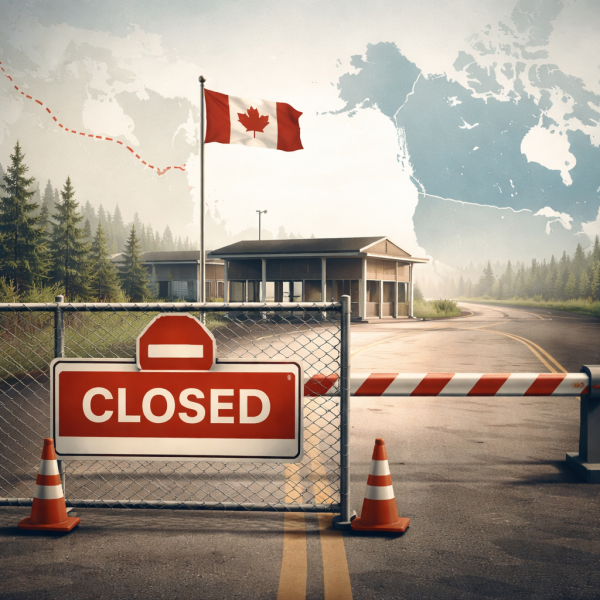
CBSA confirms permanent closure of Four Falls border crossing
The Canada Border Services Agency (CBSA) announced on May 11, 2026, that the Four Falls port of entry (POE) in New Brunswick will not reopen, formalizing a closure that has been in place since May 2020.
The crossing, located in northwestern New Brunswick, had been shut during pandemic-related travel restrictions and remained inactive for nearly six years under repeated extensions.
The decision affects cross-border movement in the region, directing travellers to nearby land crossings that continue to operate year-round.
- Closure of Four Falls POE made permanent on May 11, 2026
- Crossing has remained closed since May 17, 2020
- Location previously operated on a seasonal basis
- Approximately 8,000 travellers used the crossing per season
- Two alternate ports of entry are located within 15 kilometres
- No corresponding United States port of entry exists at Four Falls

Overview of the closure decision
The Four Falls border crossing first ceased operations on May 17, 2020, following the introduction of emergency measures that limited non-essential travel between Canada and the United States.
While several temporary border closures were lifted in subsequent months and years, this location did not resume operations. The CBSA instead extended its suspension multiple times before confirming its permanent closure in 2026.
The agency stated that the final decision followed an internal review of operational requirements across Atlantic Canada, including traffic patterns and infrastructure considerations.
Factors cited by the CBSA
According to the CBSA, several operational factors contributed to the decision to permanently close the Four Falls facility.
The crossing had functioned as a seasonal POE, typically open from mid-April through mid-October, rather than maintaining year-round service.
Traffic levels were also relatively low. The agency reported that roughly 8,000 travellers used the port during a typical operating season prior to its closure in 2020.
Additionally, two alternative crossings—Andover and Gillespie Portage—are located within approximately 15 kilometres, providing nearby options for cross-border travel.
Another factor was the absence of a corresponding inspection facility on the United States side of the border. The CBSA indicated that the closure aligns Canadian operations with existing U.S. infrastructure in the area.
Alternative crossings in the region
With Four Falls no longer in operation, travellers crossing into Canada in this region are required to use other designated ports of entry.
The Andover port of entry, located at 6 Route 190 in Carlingford, operates 24 hours a day, seven days a week, providing continuous service.
The Gillespie Portage crossing, situated at 600 Route 375 in California Settlement, operates daily between 7 a.m. and 7 p.m.
These facilities are expected to absorb traffic previously handled by Four Falls, although the volume is comparatively limited based on historical usage data.
Border reporting requirements
Under Canadian law, all individuals entering the country must present themselves at a designated port of entry and report to the CBSA.
Failure to report at an official crossing can result in enforcement measures, including financial penalties, seizure of goods, or legal action under the Customs Act or the Immigration and Refugee Protection Act.
These requirements apply uniformly across all land crossings, including those in New Brunswick and other Atlantic provinces.
Historical context of pandemic-era border measures
The closure of Four Falls originated during a broader period of restrictions introduced in March 2020, when Canada and the United States limited cross-border travel to essential purposes.
As public health conditions evolved, most restrictions were gradually eased, and many border crossings resumed normal operations.
However, certain facilities—including Four Falls—remained closed due to operational reviews and infrastructure considerations that extended beyond public health measures.
The transition from temporary suspension to permanent closure reflects longer-term planning decisions related to resource allocation and border management.
Regional and operational implications
The permanent closure of Four Falls represents a consolidation of border services within a smaller number of facilities in northwestern New Brunswick.
Given the relatively low volume of traffic historically recorded at this crossing, the CBSA indicated that nearby ports have sufficient capacity to manage regional demand.
The decision also reflects alignment with cross-border infrastructure on the U.S. side, where no active port of entry existed opposite Four Falls.
Such adjustments are part of periodic reviews conducted by the agency to evaluate efficiency, costs, and service delivery across Canada’s network of land crossings.
Broader immigration and border management context
Ports of entry play a central role in Canada’s immigration and customs system, serving as the point of inspection for travellers, returning residents, and commercial goods.
While inland immigration pathways, including provincial programs such as the Manitoba Provincial Nominee Program, operate independently of specific border crossings, all new arrivals entering Canada must complete formal inspection procedures at designated locations.
Tools such as the Manitoba PNP points calculator relate to selection processes, whereas ports of entry remain focused on admissibility and compliance checks at arrival.
The closure of a single POE does not alter immigration eligibility criteria but may affect travel routes used by individuals entering Canada in certain regions.
Ongoing access to border information
The CBSA maintains updated operational details for all land crossings, including hours of service and wait time estimates.
These updates are intended to support border planning and ensure that travellers use appropriate entry points in compliance with federal regulations.
With Four Falls now formally closed, Andover and Gillespie Portage remain the primary access points in the immediate area.
The formal closure, first implemented in May 2020 and confirmed permanently in May 2026, reflects a sustained shift in how border services are delivered in this part of New Brunswick.
Further reporting on Canadian border operations and immigration programs continues to track such structural changes across the country.