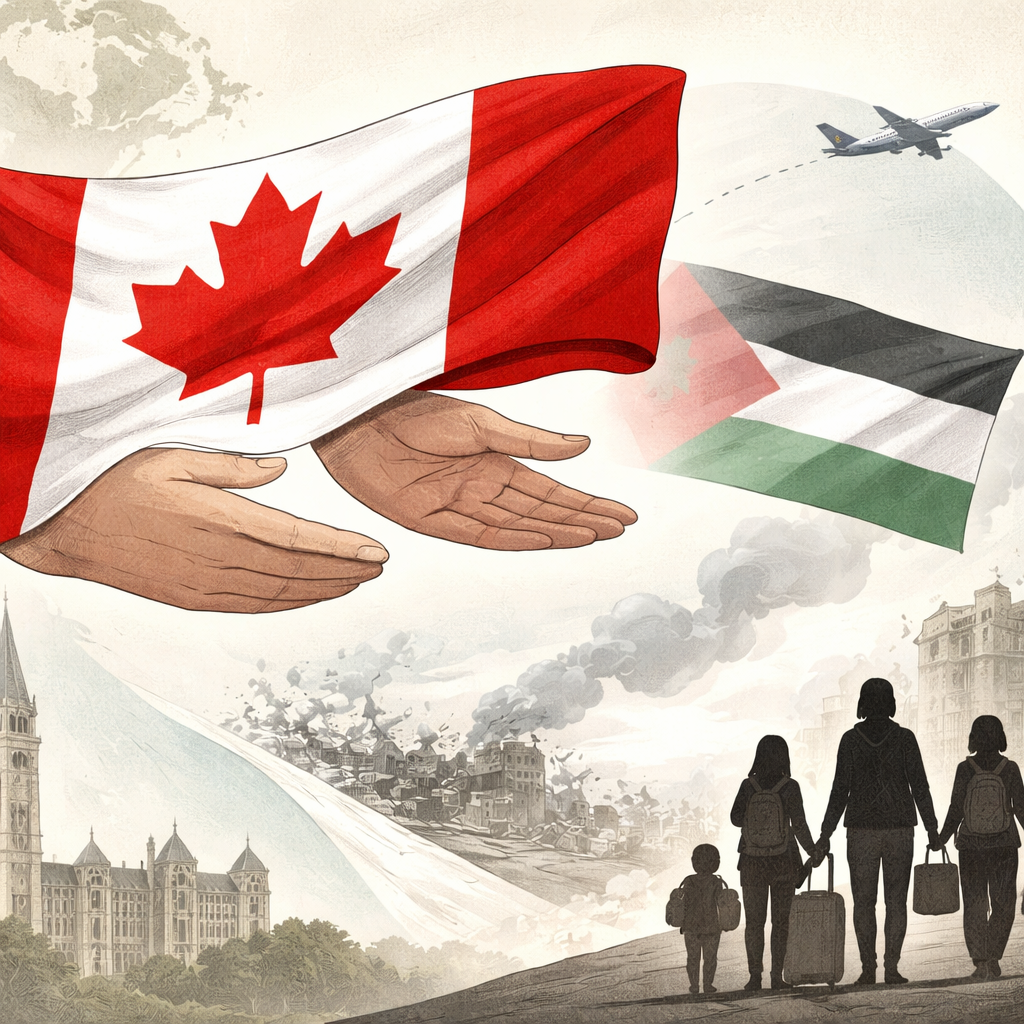
Canada extends Gaza visitor entry policy to 2028
Canada has prolonged a temporary public policy allowing certain foreign nationals in Gaza to travel to the country under eased entry conditions. The measure applies to individuals who already hold a temporary resident visa issued under earlier special provisions.
Immigration, Refugees and Citizenship Canada (IRCC) confirmed the extension will take effect on April 24, 2026, and remain in place until March 31, 2028. The department has indicated the policy can be withdrawn at any point during this period.
The update continues Canada’s response framework for individuals affected by the ongoing conflict in Gaza, specifically those previously approved under capped immigration facilitation measures.
- Policy takes effect April 24, 2026, and runs until March 31, 2028
- Applies only to individuals already issued a temporary resident visa under prior measures
- Eligible travellers can enter Canada as visitors under relaxed entry rules
- Certain financial and temporary stay requirements are waived at entry
- All other admissibility and eligibility criteria remain in effect
Overview of the extended policy
The revised public policy enables eligible foreign nationals from Gaza to continue travelling to Canada as visitors under specific exemptions. It builds on earlier measures introduced in response to humanitarian conditions linked to the Israel–Hamas conflict.
Only individuals who received a temporary resident visa through the original or updated special programs qualify under the current extension. No new applications are being accepted under this pathway.
The extension focuses exclusively on facilitating entry to Canada for those already approved, rather than reopening or expanding eligibility criteria.
Entry exemptions under the measure
Under standard immigration procedures, visitors must satisfy border officials that they will leave Canada at the end of their authorized stay. They must also demonstrate sufficient financial means to support themselves during their visit.
The temporary policy removes these two requirements for eligible individuals from Gaza. As a result, applicants are not refused entry on the basis of financial inadmissibility or concerns about leaving Canada after their visit.
Despite these exemptions, all other admissibility assessments continue to apply. This includes security, criminal, and medical screening as required under Canadian law.
Eligibility criteria for affected individuals
The extended measure applies to foreign nationals who were in Gaza and obtained a temporary resident visa under earlier facilitation efforts. These visas were issued as part of a time-limited and capped initiative.
To use the policy, individuals must be seeking entry to Canada as visitors. The measure does not create a new immigration stream or permanent residence pathway.
The eligibility scope remains unchanged from previous versions of the policy, reflecting its targeted and temporary nature.
Background to Canada’s Gaza measures
Canada first introduced special immigration measures for Gaza in December 2023. These were later revised in April 2024 to expand and structure the program into multiple components.
The updated framework included a capped application intake, with a maximum of 5,000 temporary resident visa applications accepted for processing. The program focused on individuals with close family ties to Canada.
The initiative was designed to provide a temporary pathway for affected individuals while broader immigration and humanitarian responses were being assessed.
Structure of the original program
The 2024 update divided the policy into three parts. The first component established a facilitated visa application process for Palestinian nationals in Gaza with eligible family members in Canada.
Applicants were required to identify a Canadian citizen or permanent resident willing to provide settlement support. This included assistance with housing, basic needs, and integration into public services.
The second component extended eligibility to immediate family members travelling with principal applicants, including spouses and dependent children.
The third component addressed entry to Canada, allowing approved individuals to travel and be admitted despite standard entry barriers.
Evolution of the entry provisions
The current announcement relates solely to the third component of the program. The application intake mechanisms established under the first two components have already expired.
A previous extension in March 2025 allowed entry exemptions to remain in place until April 23, 2026. The latest decision significantly lengthens that timeframe, extending it by nearly two additional years.
IRCC confirmed that while the policy is in force, it remains subject to cancellation at the government’s discretion.
Ongoing relevance of the measure
The extension ensures that individuals who were approved under earlier capped programs continue to have an opportunity to travel to Canada. It maintains continuity for those who have not yet been able to leave Gaza.
As no new applications are being accepted, the measure operates within the limits of previously approved cases. The number of potential beneficiaries is therefore fixed.
Canadian immigration policies continue to evolve in response to global events, with similar temporary public policies used in other crisis contexts.
Further reporting on Canadian immigration programs and policy updates is available through ongoing news coverage and official government releases.