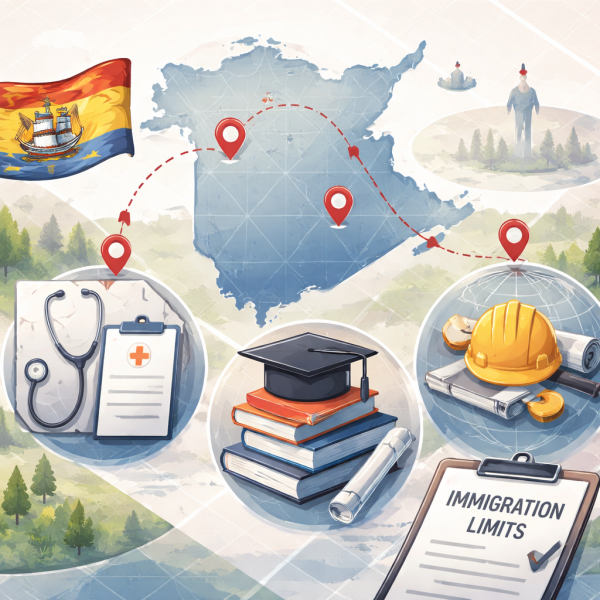
New Brunswick narrows NBPNP invitations to 3 sectors
New Brunswick has restricted invitations under a key immigration stream as of May 4, 2026, focusing only on candidates working in healthcare, education, and construction trades.
The change applies to the New Brunswick Provincial Nominee Program (NBPNP) Skilled Worker Stream’s New Brunswick Experience pathway, where invitations to apply (ITAs) are now limited to those three sectors until further notice.
Provincial officials cite limited remaining nomination spaces in 2026 as the reason for narrowing eligibility, affecting candidates currently in the Expression of Interest (EOI) pool.
- New policy effective May 4, 2026
- Applies to NBPNP Skilled Worker Stream, NB Experience pathway
- ITAs are restricted to healthcare, education, and construction trades
- Decision linked to the reduced available nomination spaces
- The estimated 2026 allocation reported at 3,603 nominations

Restriction targets three priority sectors
The provincial government has confirmed that only individuals employed in healthcare, education, and construction-related occupations will receive new invitations through the specified pathway.
The measure remains in place on an indefinite basis, with no timeline provided for when invitations might resume for other sectors.
The Skilled Worker Stream is one of the province’s main economic immigration channels, designed to support employers in filling labour shortages with foreign workers.
Reason linked to nomination capacity
Officials indicated that the restriction reflects the limited number of provincial nomination spots still available for 2026.
Although New Brunswick has not formally published its annual allocation, recent reporting has suggested the province may have approximately 3,603 nomination spaces this year.
The distribution of these spaces across individual streams and pathways has not been publicly detailed.
Impact on candidates outside selected sectors
Individuals with EOIs in the Skilled Worker Stream whose occupations fall outside the three targeted sectors remain in the system but are not currently being prioritized for invitations.
The provincial government has outlined administrative options for managing existing profiles within the immigration system.
Applicants can either withdraw their EOI and submit a new one under a different eligible pathway or maintain their current profile and create an additional submission under another program.
Submitting a second profile requires a separate account with a different email address within the provincial immigration system.
Alternative pathways within Atlantic programs
Some candidates may also meet eligibility criteria under other immigration programs administered by the province, including streams linked to employer-driven selection models.
The Atlantic Immigration Program (AIP), which operates in partnership with designated employers, remains one such pathway mentioned in provincial guidance materials.
Program-specific requirements differ, with eligibility depending on job offers, employer designation, and other regulated criteria.
Earlier 2026 reforms to New Brunswick immigration
The latest restriction follows a series of changes introduced earlier in the year that reshaped eligibility across several NBPNP streams.
On February 3, 2026, New Brunswick implemented a broad update affecting both its Skilled Worker and Express Entry streams.
As part of those changes, the province stopped accepting EOIs and issuing invitations for candidates working in accommodation and food services occupations classified under NAICS 72.
Occupation-based exclusions introduced
The Skilled Worker Stream also excluded multiple occupations spanning different sectors by removing specific National Occupational Classification (NOC) codes from eligibility.
Examples of excluded roles included cashiers (NOC 65100), retail sales supervisors (NOC 62010), and service station attendants (NOC 65101).
These adjustments signaled a shift toward prioritizing occupations more closely aligned with identified labour shortages.
Changes within the Express Entry stream
New Brunswick also updated its Express Entry-aligned stream by removing four specific NOC codes from consideration for EOIs and ITAs.
These exclusions further contributed to narrowing eligibility across multiple immigration intake pathways.
The Express Entry stream connects provincial nominations with the federal Express Entry system, allowing selected candidates to receive additional points toward permanent residence.
Other program updates and pilot extensions
Alongside these restrictions, the province extended its Private Career College Graduate Pilot through to the end of 2026.
The extension applies only to international students already enrolled in qualifying programs at two designated private career colleges within New Brunswick.
The pilot is intended to retain graduates trained within the province’s education system, particularly in fields linked to workforce demand.
Adjustments to the Atlantic Immigration Program
Concurrent updates were also made to New Brunswick’s administration of the Atlantic Immigration Program.
The AIP allows employers in Atlantic Canada to recruit foreign workers for positions they are unable to fill locally, subject to federal and provincial oversight.
Changes implemented earlier in the year modified aspects of employer participation and candidate eligibility requirements.
Role of provincial nominations in immigration system
Provincial Nominee Programs (PNPs) operate as part of Canada’s broader immigration framework, enabling provinces to select candidates who meet regional economic needs.
Each province receives a set number of nomination allocations from the federal government annually, which determines how many candidates can be nominated for permanent residence.
Once limits are approached, provinces may adjust intake strategies or restrict invitations to specific sectors or occupations.
Sector prioritization trends across provinces
Targeting key sectors such as healthcare and construction reflects ongoing labour shortages identified across multiple regions of Canada.
Healthcare occupations have remained a consistent priority due to workforce pressures in hospitals, long-term care, and community health services.
Construction trades have also been emphasized to support housing development and infrastructure projects, while education roles address staffing needs in schools and training institutions.
Current status of the NBPNP invitation process
As of early May 2026, invitations under the NB Experience pathway are being issued exclusively to individuals working within the three designated sectors.
Candidates outside those fields remain in the EOI system but are not part of current invitation rounds tied to this pathway.
The province has not announced when or if broader invitation categories will resume within the 2026 allocation period.
Ongoing adjustments to provincial immigration programs continue to reflect available nomination capacity and labour market needs, with further updates dependent on allocation levels and program demand throughout the year.
Additional reporting on Canadian provincial immigration developments continues to track program changes, including sector-specific restrictions such as those introduced by New Brunswick in May 2026.