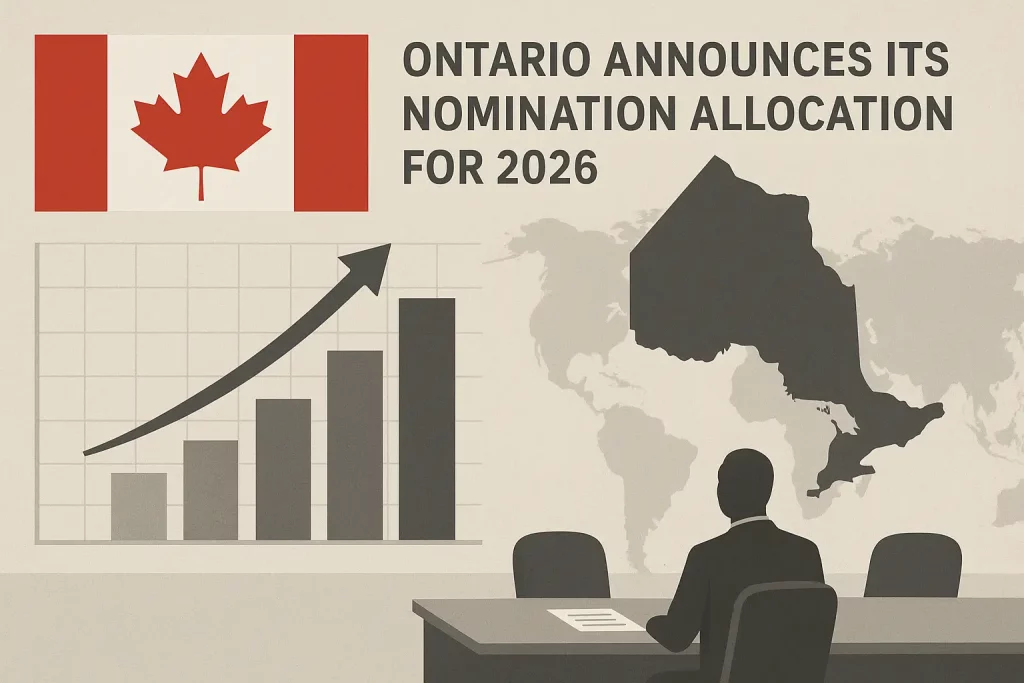
Ontario Receives 14,119 PNP Nominations for 2026
Ontario has announced its 2026 Provincial Nominee Program allocation, confirming a significant increase in the number of nominations available for the year. The province received 14,119 nominations—up sharply from its 2025 total.
The Ontario Immigrant Nominee Program (OINP) confirmed the figures on February 6, 2026, through its online update. The expanded allocation follows higher federal targets for Provincial Nominee Programs across Canada.
- Ontario received 14,119 nominations for 2026.
- The 2026 allocation reflects a 31% increase from 2025.
- Federal PNP admissions targets rose from 55,000 to 91,500 this year.
- Ontario’s share remains lower than its 2024 total of 21,500 nominations.
- Priority sectors and stream distribution for 2026 have not yet been announced.
Program Overview
The Ontario Immigrant Nominee Program enables the province to nominate economic immigrants who meet regional labour market needs. The 2026 allocation covers all eight OINP streams, including pathways aligned with the federal Express Entry system and employer-driven categories.
Ontario’s nomination levels are set annually by Immigration, Refugees and Citizenship Canada (IRCC) in coordination with provincial governments. The latest increase reflects the federal government’s plan to expand provincial immigration as part of its permanent residence admissions targets.
Comparison with Previous Years
The 14,119 nomination spaces allocated for 2026 represent a 31% rise over the previous year’s 10,750. However, the total remains below the 2024 allocation, when Ontario received 21,500 nominations. This year’s level recovers roughly two-thirds of that earlier total.
Ontario did not receive a mid-year increase to its 2025 quota, unlike several other provinces. In contrast, the 2026 rise aligns with nationwide adjustments following the federal expansion of overall PNP admissions.
National Context
The federal government’s higher target for Provincial Nominee Programs in 2026—set at 91,500 compared to 55,000 in 2025—has led several provinces and territories to announce expanded allocations. Recent increases have also been reported in Alberta, British Columbia, Saskatchewan, and Yukon.
In Manitoba, the Manitoba Provincial Nominee Program continues to play a comparable role in attracting skilled workers to meet local labour demands.
Recent OINP Regulatory and Structural Changes
Throughout 2025, Ontario introduced multiple amendments to its immigration program framework. These included adjustments to eligibility, application procedures, and oversight measures.
Changes for Self-Employed Physicians
In early 2026, Ontario extended eligibility for self-employed internationally trained physicians under the Employer Job Offer: Foreign Worker stream. The update allows certain physicians with provisional certification and an Ontario Health Insurance Plan billing number to qualify for nomination.
Earlier, in February 2025, the province had broadened eligibility for self-employed doctors across three streams, permitting periods of self-employment to count toward program criteria.
Suspension of Skilled Trades Stream
In November 2025, the OINP suspended its Express Entry Skilled Trades Stream following a compliance review. All pending applications were returned to applicants.
New Authority to Return or Suspend Applications
Regulatory changes introduced in July 2025 granted the OINP authority to return applications before a nomination decision was made. Later updates in October expanded the grounds for returning or suspending applications, including factors such as labour market demand, language proficiency, and access to provincial services.
Employer Portal Implementation
Also in mid-2025, the province launched a new electronic Employer Portal, shifting responsibility for initiating applications in Employer Job Offer streams from candidates to employers.
Updated Criteria for Early Childhood Educators
Changes announced in July 2025 lowered educational requirements for early childhood educators and assistants under the Human Capital Priorities and French-Speaking Skilled Worker streams, removing the need for a Canadian bachelor’s degree or equivalent.
Interview Requirements
Ontario also introduced the possibility of in-person interviews for both employers and applicants to strengthen application verification processes.
Proposed Stream Consolidation
Ontario has outlined plans to restructure its nominee program through a two-phase consolidation beginning in 2026. The first phase proposes combining all Employer Job Offer streams into one unified system with multiple tracks. A subsequent phase would replace most existing streams with three new pathways focused on healthcare, entrepreneurship, and exceptional talent.
The redesign remains subject to final regulatory approval, with further details expected as implementation progresses.
Public Relevance
The updated nomination allocation is part of a broader federal–provincial effort to align immigration with workforce priorities and economic growth. Ontario’s expanded quota provides additional opportunities for skilled workers, employers, and communities to address labour shortages and demographic needs across the province.
Further announcements from the OINP regarding sectoral priorities and stream-level allocations are anticipated later in 2026.
For continued updates on provincial immigration developments across Canada, follow related coverage on program announcements and quota adjustments.