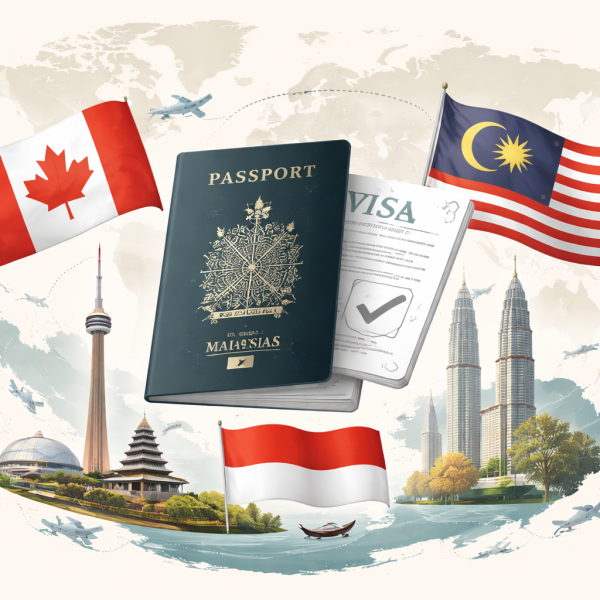
Canada expands eTA access to Indonesia and Malaysia travellers
Immigration, Refugees and Citizenship Canada (IRCC) announced on May 25 that selected citizens of Indonesia and Malaysia will be able to travel to Canada without a traditional visitor visa starting May 26 at 5:30 a.m. Eastern Daylight Time.
The change introduces access to Canada’s electronic travel authorization (eTA) system for eligible individuals arriving by air, replacing the requirement to obtain a temporary resident visa (TRV) in certain cases.
The update affects travellers from both Southeast Asian countries who meet specific pre-screening criteria based on prior travel history to Canada or the United States.
- Eligible Indonesian and Malaysian citizens can apply for an eTA instead of a visa
- The policy takes effect on May 26 at 5:30 a.m. EDT
- Applicants must have recent Canadian visa history or hold a valid U.S. visa
- Travel must be by air to qualify under the new rules
- Standard visitor visa rules remain for land and sea arrivals
- The eTA fee remains set at $7 CAD

Policy change introduces conditional visa-free air travel
The latest measure allows certain travellers from Indonesia and Malaysia to bypass the standard visitor visa process when flying to Canada. Instead, they can apply online for an eTA, a digital entry authorization linked to a passport.
Before this update, all citizens of these countries were required to obtain a TRV prior to travel. Processing times for visitor visas can extend from several weeks to months, depending on application volumes and individual circumstances.
Under the revised policy, only individuals who meet defined eligibility criteria can access the eTA pathway. Others must continue to follow existing visa requirements.
Eligibility criteria for eTA access
To qualify, applicants must be travelling by air to or through Canada and meet at least one of two conditions at the time of application.
IRCC specifies that eligible travellers must either have held a Canadian temporary resident visa within the past 10 years or currently possess a valid United States non-immigrant visa.
These individuals are categorized as previously screened travellers, reflecting prior vetting conducted by Canadian or U.S. immigration authorities.
Citizens of Indonesia and Malaysia who do not meet these conditions must still apply for a visitor visa if travelling to Canada.
Travel conditions remain limited to air entry
The eTA program applies exclusively to air travel. Individuals entering Canada by land or sea—including by car, train, bus, or cruise—are still required to obtain a visitor visa regardless of eligibility for an eTA.
Existing visa holders from Indonesia and Malaysia can continue using valid TRVs until expiration. There is no requirement to switch to an eTA before the visa or associated passport expires.
Application process and validity period
The eTA application process is conducted entirely online through IRCC systems. Applicants must provide passport details, an email address, and payment using a credit or debit card.
The government fee for an eTA remains $7 CAD per application. Most decisions are issued within minutes, although additional documentation may be requested in some instances.
When further review is required, IRCC typically sends follow-up instructions within 72 hours of submission.
An approved eTA is electronically linked to the traveller’s passport and remains valid for up to five years or until the passport expires, whichever occurs first.
During its validity period, the authorization allows multiple entries to Canada by air, provided that travellers continue to meet admissibility requirements assessed at the border.
Differences between eTA and visitor visa
The eTA system differs from the traditional visitor visa in processing time, documentation requirements, and cost structure. Visitor visa applications typically involve biometric submission and supporting documentation.
In contrast, eTA applications are shorter and do not require biometrics in most cases. However, holding a valid eTA does not guarantee entry into Canada.
Border services officers retain authority to assess admissibility upon arrival, consistent with standard immigration procedures.
Context within Canada’s Indo-Pacific engagement
The expansion of eTA eligibility aligns with Canada’s broader Indo-Pacific Strategy, which focuses on strengthening economic and diplomatic ties across the region.
Indonesia and Malaysia are identified as key partners in Southeast Asia, with growing bilateral engagement in trade, investment, and mobility.
According to government figures, Canada recorded approximately 18,300 visitors from Indonesia and 11,500 visitors from Malaysia in 2025.
The adjustment to entry requirements is part of efforts to facilitate travel while maintaining screening standards.
Previous expansions of the eTA program
Canada has incrementally expanded its eTA framework in recent years to include additional countries under conditional eligibility rules.
In June 2023, 13 countries were added to the program under similar criteria requiring prior Canadian or U.S. visa history. These included nations such as the Philippines, Thailand, Argentina, and Morocco.
In a separate development in November 2025, Canadian authorities introduced full visa exemptions for Qatari citizens, allowing broader access without conditional screening requirements.
The current update for Indonesia and Malaysia follows the conditional model rather than a full visa waiver.
Position within Canada’s immigration system
The eTA system operates as part of Canada’s broader temporary entry framework, which includes visitor visas, work permits, and study permits.
While the policy primarily affects short-term travel, it exists alongside broader immigration pathways such as provincial nomination programs and federal economic streams.
Data on selection trends and immigration activity can be explored through resources tracking draws, including the Express Entry draws, which provide insight into permanent residence invitations issued across categories.
Although separate from permanent immigration pathways, temporary entry policies such as the eTA can influence travel flows and short-term mobility between Canada and partner countries.
Ongoing policy adjustments
IRCC indicated that the latest change forms part of a broader approach to diversify Canada’s international engagement while preserving border integrity.
Adjustments to entry rules are periodically reviewed based on travel patterns, diplomatic priorities, and administrative capacity.
The introduction of conditional eTA eligibility reflects a balance between facilitating travel and relying on existing screening systems conducted by trusted partner countries.
Details of immigration developments, including travel and entry requirements, continue to evolve alongside Canada’s international mobility strategies.
Further updates on immigration pathways and selection activity remain available through Canada’s ongoing reporting on programs and draws, including those tracked in the Express Entry system.