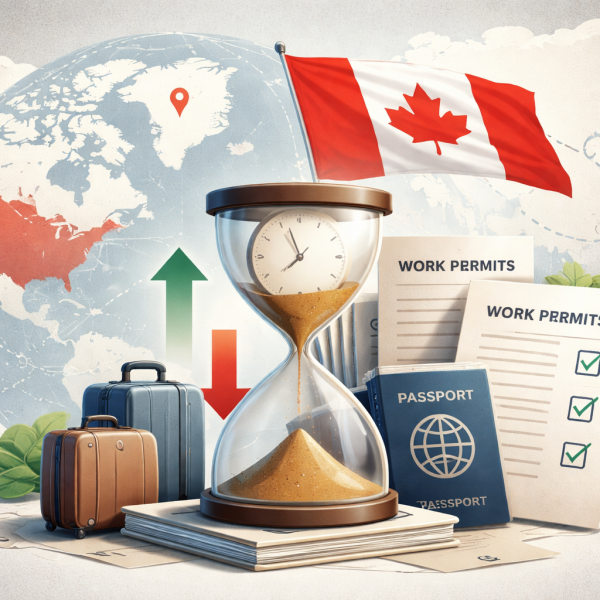
IRCC Updates Temporary Residence Processing Times
As of May 6, 2026, Immigration, Refugees and Citizenship Canada (IRCC) has released updated processing timelines for several temporary residence application categories, showing notable week-over-week changes between April 29 and May 6.
The most significant declines were recorded for study permit applications submitted within Canada, which dropped by two weeks, and super visa applications processed from the United States, which fell by 12 days.
These updates affect international students, temporary workers, and visitors applying from key countries, reflecting ongoing shifts in application volumes and processing capacity.
- In-Canada study permit processing times decreased by two weeks
- U.S.-based super visa processing declined by 12 days
- Work permit processing times fell by one week for Nigeria and the United States
- Pakistan-based study permit timelines increased by two weeks
- Visitor visa processing times remained largely stable with minor increases

Overview of IRCC Processing Time Updates
IRCC regularly updates its estimated processing times to reflect current operational conditions, including application inventory levels and available processing resources. These estimates provide a snapshot of how long most applications take to be finalized.
The latest update highlights mixed movement across temporary residence streams, with some reductions in wait times alongside increases in specific regions. Processing estimates differ depending on the country of application and the type of permit requested.
Temporary residence categories covered in this update include work permits, study permits, visitor visas, and parent and grandparent super visas.
Work Permit Processing Times Show Mixed Changes
Work permit timelines shifted modestly during the latest reporting period. Applicants from Nigeria and the United States experienced a one-week decrease in processing times, while those applying from the Philippines saw a one-week increase.
Applications submitted from within Canada decreased slightly from 217 days to 212 days. Processing times for applicants from India and Pakistan remained unchanged at nine weeks and eight weeks respectively.
IRCC maintains service standards of 120 days for in-Canada work permit applications and 60 days for those submitted outside the country. Applications under the International Experience Canada program continue to follow a 56-day standard.
Study Permit Processing Times Decline in Select Locations
Study permit processing times showed a more pronounced reduction for applicants already in Canada, decreasing from eight weeks to six weeks over the one-week period.
Applications from the United States also saw a decline, with timelines reduced from six weeks to five weeks. In contrast, applicants in Pakistan experienced an increase from nine weeks to 11 weeks.
Processing times remained steady for India and Nigeria at four weeks and five weeks respectively, while the Philippines saw a one-week increase to five weeks.
IRCC’s service standard for study permit applications remains 120 days for in-Canada submissions and 60 days for those filed from outside Canada.
Visitor Visa Processing Times Largely Stable
Visitor visa processing timelines remained relatively unchanged during this period. Most countries experienced either no change or slight increases of up to two days.
Applications from within Canada continued to be processed in approximately 11 days, while those from India held steady at 27 days. Processing times rose slightly for Pakistan and Nigeria, reaching 50 days and 47 days respectively.
Applicants from the United States saw no change at 22 days, while the Philippines recorded a small increase to 18 days.
The service standard for visitor visas processed outside Canada is set at 14 days, although actual processing times often exceed this benchmark depending on application volumes and regional demand.
Super Visa Processing Times Decline in Most Regions
Super visa processing times showed consistent reductions across most countries included in the update. The largest decrease was recorded for applicants from the United States, where processing dropped from 115 days to 103 days.
Applications from India declined from 168 days to 160 days, while Nigeria and the Philippines also experienced shorter processing times at 35 days and 32 days respectively.
Pakistan was the only country in this category to record an increase, with processing times rising from 102 days to 107 days.
The current service standard for super visa applications is 112 days, which serves as a target for processing the majority of cases.
Understanding Processing Times and Service Standards
IRCC distinguishes between processing times and service standards when reporting its operational performance. Processing times represent estimated durations based on the completion of a majority of applications within a specific category.
These estimates are calculated using two methods: historical data, which reflects how long it took to finalize 80 percent of applications, and forward-looking projections based on current inventory and processing capacity.
Service standards, by contrast, are internal benchmarks that outline the department’s target timelines for completing applications. These standards aim to ensure that most cases are finalized within a specified period, although more complex files may take longer.
Processing times are updated on a weekly or monthly basis, depending on the application type, while service standards have remained largely unchanged since their most recent revisions in 2018 and 2019.
Context Within Canada’s Immigration System
Temporary residence pathways form a key component of Canada’s broader immigration framework, supporting labour market needs, educational institutions, and family reunification objectives.
Applicants who enter Canada through temporary permits may later transition to permanent residence through programs such as the Provincial Nominee Program. Manitoba, for example, operates the Manitoba Provincial Nominee Program, which selects candidates based on labour market criteria and regional priorities.
Eligibility for such programs is assessed using defined criteria, including points-based systems. Tools such as the MPNP points calculator outline the factors used in selection, including education, work experience, and language proficiency.
While processing times for temporary residence applications are distinct from permanent residence pathways, changes in temporary streams can influence broader immigration patterns.
Recent Trends and Public Relevance
The latest IRCC update reflects incremental adjustments rather than system-wide changes, with reductions in some categories offset by increases in others.
Fluctuations in processing times are influenced by application intake levels, staffing resources, and seasonal demand patterns, particularly in study permit streams tied to academic calendars.
The reported two-week reduction for in-Canada study permits and the 12-day decline for U.S. super visas stand out as the most notable changes in the current reporting period.
Ongoing updates to these timelines provide a regularly refreshed view of IRCC’s operational status as it processes temporary residence applications across multiple global regions.
Further updates are expected as IRCC continues to revise its estimates based on application volumes, including future reporting cycles following the May 6, 2026 update period.