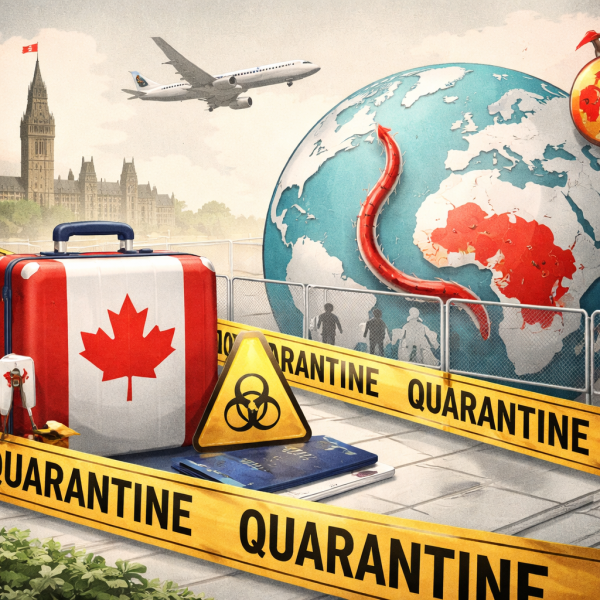
Canada introduces quarantine rules for travellers linked to Ebola outbreak
Canada will enforce new quarantine measures starting at 11:59 p.m. EDT on May 30, 2026, targeting travellers who have recently been in regions affected by an Ebola outbreak. The policy is scheduled to remain in effect until August 29, 2026.
The measure applies to individuals arriving from the Democratic Republic of Congo, Uganda, and South Sudan. Federal authorities have framed the action as part of an ongoing public health response to limit potential transmission risks.
Officials have indicated that the requirements could be expanded to additional locations if the outbreak spreads to other areas.
- Quarantine rules begin May 30, 2026, at 11:59 p.m. EDT
- Applies to travel history within 21 days of arrival in Canada
- Initial countries affected: Democratic Republic of Congo, Uganda, South Sudan
- Mandatory quarantine period set at 21 days
- Separate isolation protocols in place for symptomatic travellers
- Measures scheduled to end on August 29, 2026

Scope of the quarantine requirement
The quarantine directive covers a broad category of travellers, including Canadian citizens, permanent residents, individuals registered under the Indian Act, and foreign nationals. The determining factor is whether a person has been present in any of the specified countries within the previous 21 days before arriving in Canada.
Travellers who meet this condition and do not exhibit symptoms are required to isolate for a full 21-day period upon entry. Authorities have confirmed that individuals unable to secure suitable quarantine accommodations will be provided with a designated facility.
In contrast, those displaying symptoms associated with Ebola will not follow the standard quarantine process. Instead, they will be transferred to a hospital for medical evaluation and containment procedures.
Part of a broader federal response
The quarantine policy forms one component of a wider set of measures introduced by the federal government in response to the Ebola outbreak. Earlier in the same week, Canada implemented temporary immigration-related restrictions affecting residents of the same three countries.
Beginning May 27, 2026, authorities suspended the issuance of visitor visas, electronic travel authorizations (eTAs), and permanent resident visas for individuals residing in the Democratic Republic of Congo, Uganda, and South Sudan. Processing of new immigration applications from these regions was also paused.
These immigration restrictions are set for a 90-day duration and are distinct from the quarantine rules. While visa suspensions target those planning to travel to Canada, quarantine requirements apply to anyone who has recently been in the affected regions, regardless of citizenship or immigration status.
Distinction between travel bans and quarantine measures
The dual approach separates entry eligibility from post-arrival requirements. Immigration processing suspensions limit new arrivals from specific countries, while quarantine rules govern health protocols for those who are already permitted to travel.
This distinction ensures that Canadian citizens and permanent residents continue to retain entry rights, while still being subject to public health safeguards. The framework reflects a layered response combining immigration controls with health-based screening and containment measures.
Historical context of quarantine policies in Canada
The current policy marks the first time since 2022 that Canada has reintroduced quarantine requirements at its borders. That year, the country lifted extensive pandemic-related travel restrictions that had been in place during the COVID-19 period.
During the COVID-19 pandemic, quarantine obligations applied broadly to international arrivals, often requiring isolation in designated facilities or approved residences. Those measures were gradually phased out as vaccination coverage increased and public health conditions improved.
The reintroduction of quarantine requirements in 2026 reflects a targeted approach rather than a universal one. Instead of applying to all travellers, the current policy focuses specifically on individuals with recent exposure to regions experiencing an Ebola outbreak.
Public health considerations and monitoring
Federal authorities continue to monitor the Ebola situation in the affected regions. Public health decisions related to border measures are based on evolving outbreak data and risk assessments.
The government has indicated that the list of affected countries may be revised if additional regions experience significant transmission. Similarly, the duration of the measures could be adjusted depending on how the outbreak develops.
Canada’s response aligns with international practices that prioritize containment of highly infectious diseases through travel-related controls and monitoring systems. Ebola, known for its severity and transmission through direct contact, typically prompts stringent border health measures.
Implications for immigration and travel systems
The introduction of quarantine rules adds another operational layer for Canada’s border and immigration systems. Screening processes at ports of entry are expected to include travel history verification covering the previous 21 days.
Airlines and border officials may also play a role in identifying travellers subject to quarantine measures before and after arrival. Coordination between public health agencies and immigration authorities is required to implement the policy consistently.
Canada’s broader immigration framework, including federal and provincial programs, remains in place despite these temporary measures. Programs such as the Manitoba Provincial Nominee Program (MPNP) continue to operate independently of the health-related restrictions, although processing pauses apply to applicants from the specified countries.
Ongoing updates and official advisories
Authorities have advised that updates will be issued as the situation evolves. Travel advisories and public health notices remain key tools for communicating changes related to border measures.
Information on quarantine protocols, immigration processing pauses, and affected regions is expected to be reviewed regularly in line with outbreak developments. These updates may include adjustments to timelines, geographic scope, or procedural requirements.
The current policy remains scheduled until August 29, 2026, with the quarantine requirement set at 21 days for eligible travellers, reflecting the defined incubation period used in the measure.
Further immigration and travel-related developments continue to be tracked across federal and provincial systems, including recent updates listed in the broader All Draws Index, as Canada maintains its standard immigration operations alongside temporary public health controls.